
DNS Exfiltration Writeup
🧠 Overview
This is one of the CTF challenges I tackled as part of the 2025 Dewald Roode Cybersecurity Hackathon.
Problem:
A compromised host on the network is exfiltrating sensitive data by tunneling it over DNS queries to an external, attacker-controlled domain. Your task is to identify the compromised host, reconstruct the exfiltrated data, and ultimately find the flag.
Enumeration
What we need to look for is: 1) a host that is making a high number of DNS requests in a short time or 2) domains with long, random-looking subdomains.
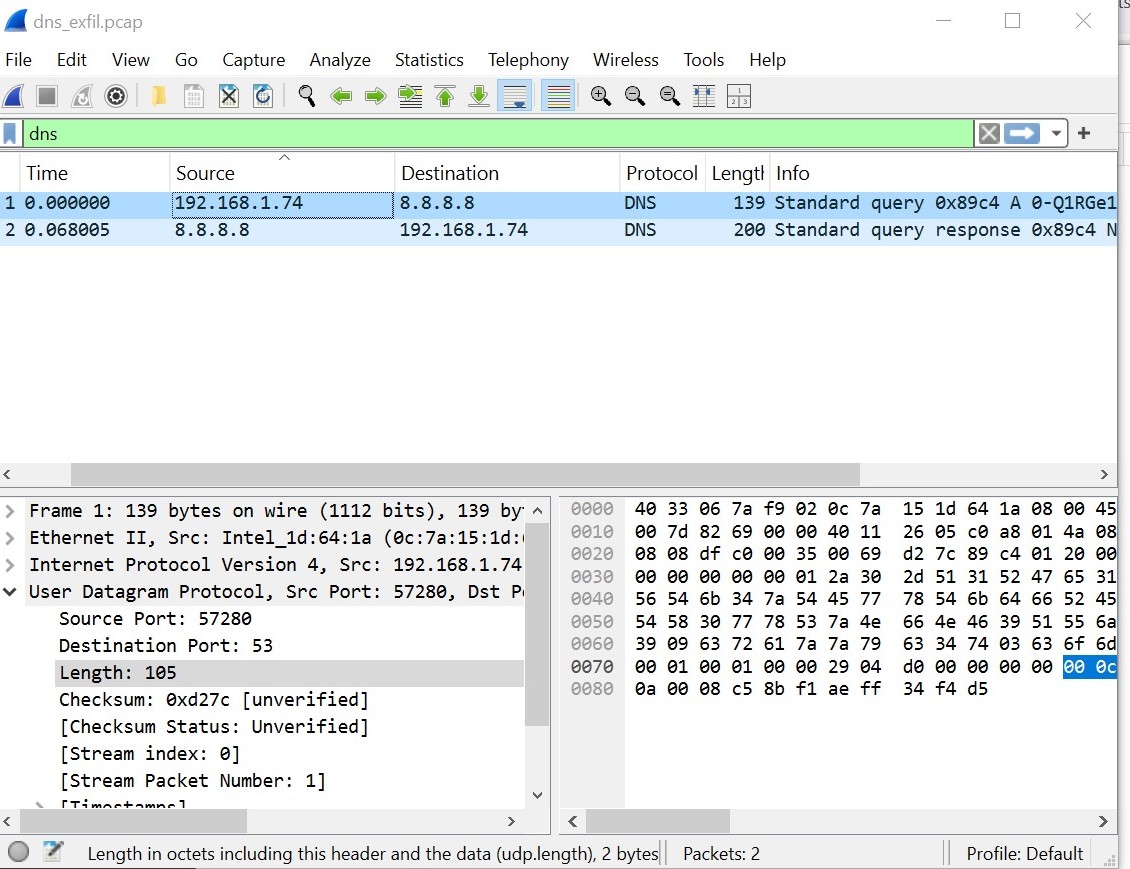
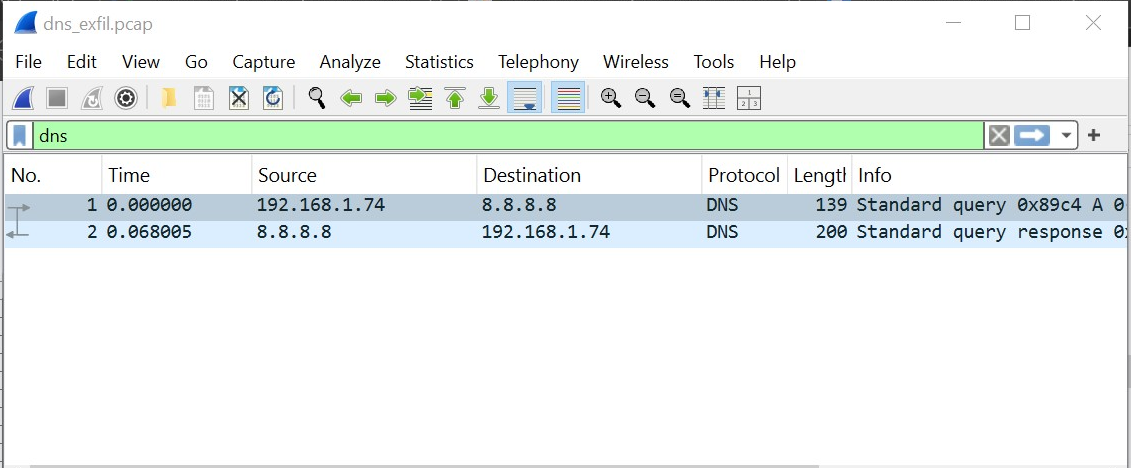
Let’s do just that by analysing the PCAP file on Wireshark. There’s only one IP (192.168.1.74) that has issued DNS requests as shown below.
Now let’s extract DNS queries from this IP and save in a file named queries.txt. Then we clean the data so that we have only Base64 (remove any domains present). The next script command joins the base64 parts into one line.
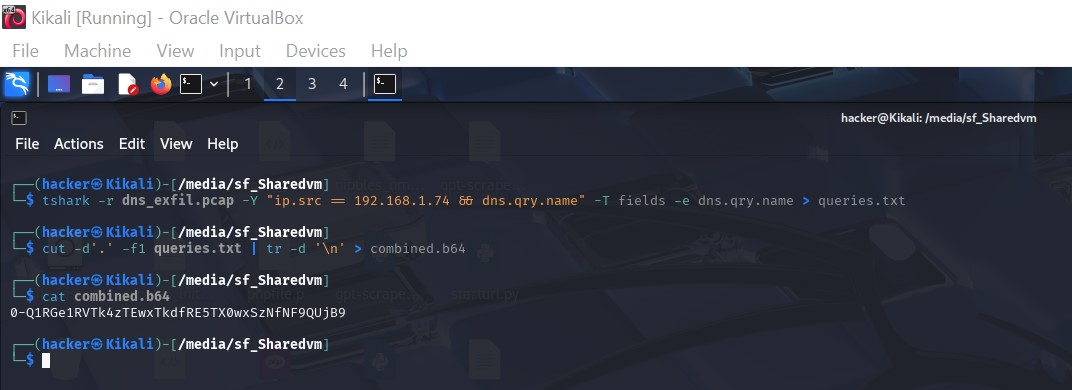
Next, we inspect the base64 string above to decode it. After the 0-, the rest of the code is clearly Base64.
Q1RGe1RVTk4zTEwxTkdfRE5TX0wxSzNfNF9QUjB9
Decode Base64
To decode the base64 we use:
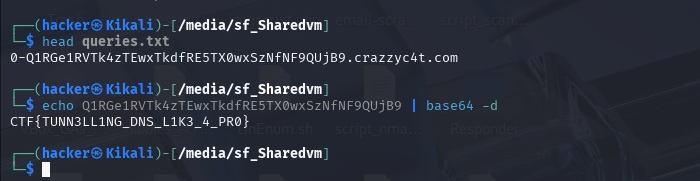
🎉 That’s our flag!
Now we can answer the following questions:
What is the full domain name used by the attacker for data exfiltration?
Crazzyc4t[.]com
So the attacker likely registered crazzyc4t[.]com and configured it to receive and log DNS queries for exfiltration.
What encoding method was used for the exfiltrated data within the DNS queries?
Base64
What type of DNS record did the attacker use for data exfiltration
The query type is A
Key Lessons We Learned
- This attack incident was an exfiltration over DNS.
- Attackers encoded data into the subdomain of a DNS query and sent it to a domain they control (crazzyc4t[.]com). The attacker’s server logs this query and decodes the base64 chunk.
- This query typically asks for an A record, which resolves a domain to an IP address (attackers can also use TXT or MX records).